The Scientific Revolution
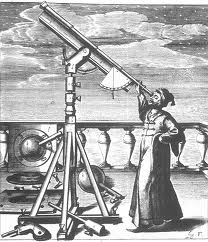
The Scientists
Nicolaus Copernicus was the first scientist to challenge the medieval view of the universe. The medieval belief was that the sun revolved around the earth. Copernicus tracked the position of the planets, and realized that the Earth actually revolved around the sun. However, nobody believed him and he was ridiculed for his beliefs.
A German astronomer named Johannes Kepler used mathematics to prove Copernicus right. However, he could not figure out the force that kept Earth around the sun.
Galileo Galilei also supported the beliefs of Copernicus. He experimented with motion and the laws of nature by conducting his own experiments. He also built his own telescope and observed the celestial objects. However, the Catholic Church did not like Galileo's findings and forced him to reject them.
Later, a man known as Issac Newton was experimenting with motion and tried to figure out why objects fall. He realized there was a force known as gravity causing it. He described it as the law of gravity. Finally, people began to believe him and the previous scientists' beliefs.
Two men, Francis Bacon and Rene Descartes formed the foundations for the scientific method. Bacon wanted people to use inductive reasoning, or using facts to form principles. Descartes said to doubt everything but the certain truth. He stated, "I think, therefore I am". Together, their ideas formed today's scientific method.
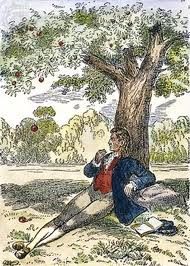
Issac Newton watches an apple fall from a tree and wonders why it falls.
The Enlightenment
Enlightenment thinkers focused on political, social, and economic thought. John Locke was one of the first Enlightenment thinkers. He believed that people had 3 natural rights that could not be taken from them: life, liberty, and personal property. He also believed in tabula rasa, or the idea that people are born not good or bad. Their environments make them what they will become when they grow older.
Baron de Montesquieu came up with the idea of today's government. He believed that there should be three branches that make sure each of them do not grow too powerful. These branches are the executive, judicial, and legislative branches.
Jean Jacques Rousseau believed in the idea of a social contract. He said that "people are born free, and everywhere they are in chains." In a social contract, the people had to give up some of their freedom and in return, the government would protect their rights and keep order and peace.
Voltaire was an Enlightenment writer that believed in religious tolerance and social justice.
Mary Wollstonecraft worked to improve women rights. She believed that women should have an education as well as men. She believed that women were lower in the society because they did not have an education and were not as intelligent as men.
Adam Smith was a Scottish writer that wrote a book called The Wealth of Nations. He believed that the government should not interfere with the economy and that the economy is best when it gets to make its own decisions.
These people's ideas all influenced the Magna Carta, The English Bill of Rights, and the Declaration of Independence. Today, all of these people influence our country today in more ways than we realize. They formed the foundation for our country.
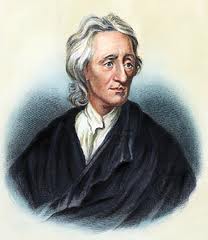
John Locke
