The Tang Dynasty
After the Han Dynasty fell, China was split into several kingdoms. Eventually, the Tang dynasty reunited China. It was led by a man known as Tang Taizong. During this dynasty, the nation was greatly expanded and covered a large area. The country also had a very strong government, known as a bureaucracy, where a government had several departments and certain officials were assigned to them. The capital during this period was located in the city of Chang'an. The city was one of the largest cities ever built and was set up in a grid pattern.
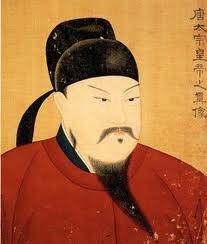
Tang Taizong
The Song Dynasty
Eventually, the Tang Dynasty collapsed and a new dynasty known as the Song Dynasty arose. It was a period with a very good government. The government contained scholar-officials that ran the bureaucracy. These were highly educated civil servants who had to pass a test known as the merit system. They had to be very intelligent and have a lot of talent in order to join the government. During this period, the capital was moved to the wealthy trading city of Hangzhou.
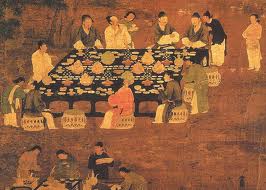
Scholar-Officials
The Mongols and the Yuan Dynasty
Eventually, China was conquered by the Mongols. At first, the Mongols were nomads led by leaders known as khans. A khan known as Genghis Khan eventually began to conquer nearby rival tribes. All of the Mongols were soon united under Genghis Khan. The newly formed empire continued to expand into China, across central Asia, the Middle East, and even central Europe. In fact, the Mongol empire was the largest empire in all of history. There are several reason why they were so successful. Reasons include good military leaders, ruthlessness, fierce warriors, new weapons, and good organization and law among the Mongols.
Genghis' grandson, Kublai Khan continued to push into China. It took a while, but Kublai Khan conquered all of China, becoming its ruler. He started the Yuan Dynasty. He kept a lot of the practices of Chinese government, but added many new aspects as well. He also created a new social order, where the Mongols were on top, foreigners were next, the Northern Chinese were after, and the Southern Chinese were at the bottom. He also encouraged trade and reopened many abandoned trade routes.
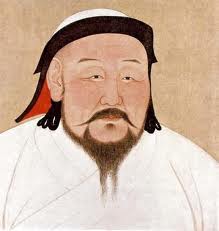
Kublai Khan
The Ming Dynasty

Emperor Hongwu
Chinese Religion and Beliefs
There were three main Chinese religions: Daoism, Buddhism, and Confucianism. The earliest of these religions was Daoism. The main idea of the religion is to withdraw from society and live in nature. It is a religion based on nature.
Buddhism was based on the teachings of Siddhartha Gautama, or the Buddha. The religion teaches that you must give up worldly desires to ease suffering. Once you do this, you will achieve perfect wisdom known as enlightenment, and enter nirvana, a state of complete peace. There were two main Buddhist sects in China: Pure Land Buddhism and Chan Buddhism. Pure Land Buddhism emphasized faith to achieve salvation, while Chan Buddhism emphasized meditation and awareness in order to achieve enlightenment.
The last of these three religions was Confucianism, which was based on Confucius' beliefs. Confucianism taught to respect the social order and you family. It also stressed the importance of moral virtue and to be a good person. Neo-Confucianism was a form of Confucianism influenced by Buddhism and Daoism. Confucianism was a philosophy, while Neo-Confucianism taught that you must live according to the Dao. In this case, the Dao is a process of self-improvement through learning and education.
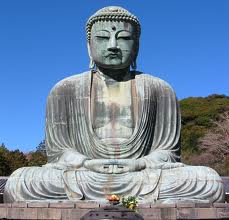
Statue of Buddha
Chinese Technology and Inventions
China invented many things and had very advanced technology for its time. China built large and complex ships with rudders and watertight compartments. They also invented the compass, which greatly helped in navigating the open sea. They invented gunpowder as well. They used it to create fireworks and many weapons. Finally, they invented paper and movable type printing. With these two inventions, many more books were created and the literacy rate went up.

Gunpowder
