The Early Days of the Roman Empire
In its early days, the Roman empire started out as a republic. In a republic, the people got to vote for who they wanted to be the ruler. The rulers would then serve one year terms. However, after the empire grew larger, a republic government did not work as well anymore. The people did not know their rulers and did not know whether they were good rulers or not.
Julius Caesar
Soon, a popular military hero known as Julius Caesar emerged to stabilize and take control of the government. He had been a very good general in the army. He had been especially famous for conquering Gaul, which is modern day France. He soon led a large army into Rime, which started a civil war between his supporters, and his opponents. Caesar emerged victorious, and was declared "dictator for life".
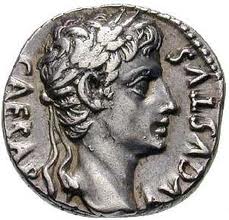
Coin with Julius Caesar on it
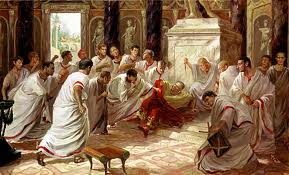
However, many people began to think that Caesar was becoming too powerful. Soon, a group of Roman senators plotted against Caesar and assassinated him. This brought about another civil war where many people tried to take control of Rome.
Augustus Caesar and the "Good Rulers"
Caesar's adopted son, Octavian, emerged triumphant from this civil war. He was soon declared emperor of Rome and he named himself Augustus, or "the great and holy one". He was a very wise and strong ruler. He made many reforms throughout the empire and conquered many new lands.
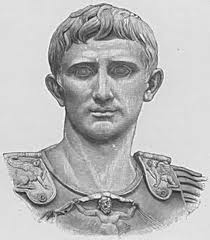
During Augustus' reign, Rome entered the longest period of peace during the history of the Roman empire, known as the Pax Romana. It lasted even after Augustus died in A.D. 14.
After August died, there was a mix of good and weak rulers. There were several "good rulers", including Trajan, Hadrian, and Marcus Aurelius. Trajan was a good military leader. During his reign, the empire reached its greatest size. Hadrian worked to build up the empire's defenses. One of his greatest projects was Hadrian's wall, which is located across north Britain. Marcus Aurelius was the last "good ruler". He was a peace-loving scholar. However, he still spent most of his reign fighting invasions and wars in the eastern part of empire.
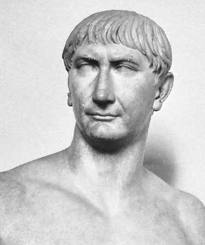
Trajan
The Fall of the Roman Empire
A Roman emperor named Diocletian soon realized that the empire had become too large. He decided to divide it into two halves, the west and east halves. However, this decision actually made the empire weaker, and was one of the causes of the downfall of Rome.
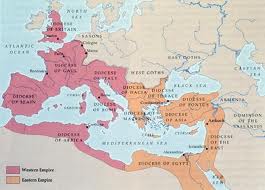
The western Roman empire soon began to collapse. The government was corrupt, there were endless wars, the economy was weak and failing, many foreign troops joined the army which weakened it, and countless other reasons all participated in the fall of Rome.
The western Roman empire soon came to an end after several barbarian invasions. It started with the Huns invading, followed by numerous Germanic tribes such as the Visigoths, Ostrogoths, Franks, and many other barbarian tribes. Finally, the Visigoths stormed Rome and forced the last Roman emperor to resign from office. Clovis, king of the Franks, defeated the last Roman army in Gaul ten years later, officially putting an end to the Western Roman Empire.
