Constantine and the Byzantine Empire
The Byzantine Empire, or the Eastern Roman Empire, continued to live even after the fall of the Western Roman Empire. Constantine was a Roman ruler after Diocletian. He was a devout Christian and made the Byzantine empire a Christian empire. He brought about several changes to the empire.
One thing he did was move the capital to the city of Byzantium, which he then named Constantinople after himself. The location of the city was very good. It was near a straight linking the Black and Mediterranean Seas. The location was a natural trade route and had a lot of trade, therefore supporting a strong economy. The city was nearly surrounded by water on all sides, making it very easy to defend. The city soon became very rich, which Constantine used to build many buildings in the city. Because of Constantine's good rule, the Eastern empire managed to survive.
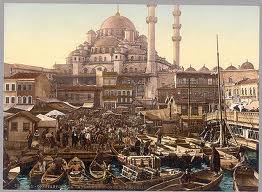
Constantinople
Justinian and Theodora
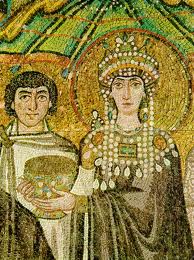
Justinian and Theodora were the first great Byzantine emperors after the split of the Western and Eastern Roman Empires. They were both very talented, self-confident, and intelligent, making them two very good rulers. Justinian tried to bring the Roman empire back to its former glory. During his reign, the Byzantine empire reached its greatest size. It was almost as large as the former Roman empire, but it did not last long however. There were severe money problems and invaders slowly decreased the size of the empire bit by bit.
Justinian also had many other accomplishments. He created Justinian's Code, which is a law code that many modern laws are based off of. He also began a massive building program in Constantinople. One of the buildings included in this program was the Hagia Sophia, a very large palace with a huge dome.
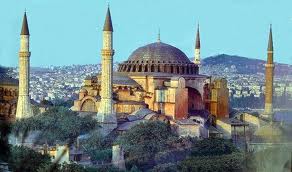
The Hagia Sophia
Christianity in the Byzantine Empire
Christianity was one of the largest religions in the Roman empire. In it, there were 5 major bishops who ruled over a large religious area, these bishops were known as the Patriarchs. They were the bishops of Rome, Jerusalem, Alexandria, Constantinople, and Antioch.
Soon, the bishop of Rome claimed that he was the bishop of every Christian and that he would be the Pope. He argued that Peter was given authority to be the head of the Church, and he had been the first bishop of Rome. Soon, the Pope became the religious ruler of the Western Roman Empire.
Different groups of Christians began to argue about Christianity and the nature of Jesus. The bishops soon came together in Nicaea (located in present-day Turkey) and created the Nicene Creed, a statement of Christian beliefs that all Christians should follow.
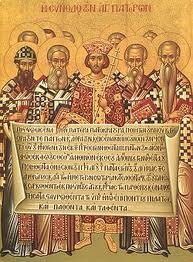
The creation of the Nicene Creed
Eventually, the Eastern and Western Churches began to become more and more different. The Western side created the Roman Catholic Church, while the Eastern side created the Greek Orthodox Church. These two sects had many differences, including their beliefs and rituals. After a while, the two Churches split completely from each other. The original Roman empire practiced the Roman Catholic religion, while the Byzantines practiced the Greek Orthodox religion.
The Fall of the Byzantine Empire
The end of the Byzantines came after several invasion from outside countries. It managed to hold on for a long time. Finally, in 1453, the Turks attacked Constantinople with a new weapon, cannons. The cannons quickly brought down the walls and the Turks stormed Constantinople. The Byzantine empire was soon no more.
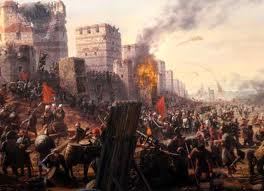
The fall of Constantinople
